You’ll find our newsletters in the newsletter archive.
10 Years of farip – From “Farmer Spy” to Friend – A journey through time with Ueli Scheuermeier and Bahat Tweve
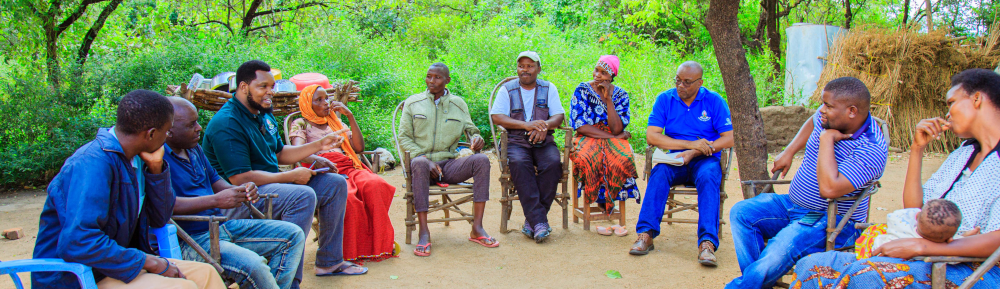
 2026-07-02. It was probably around 25 years ago when I first met Bahat Tweve. We met in the office of Mama Nyanzali, who led the district’s agricultural advisory service. At the time, I was working in the southern highlands of Tanzania as a consultant for the International Fund for Agricultural Development (IFAD). Mama Nyanzali introduced Bahat with a smile as the Mkulima Shushushu – the «farmer spy». A farmer spy? Yes. Bahat was both an excellent farmer and an experienced trader. He travelled to town markets to find out what prices farmers could really achieve for their maize if they negotiated hard enough. He knew the markets from the inside and understood the long and complex journey from the field to people’s plates. Before long, we were exchanging ideas with farmers and traders in Kenya and Uganda. We learned a great deal together. Very quickly, one topic became central to every discussion: marketing. «We know how to produce,» the farmers said. «But why should we grow more if we receive almost nothing for the surplus?»
Bahat was always the practical thinker. Again and again, he reminded us that one day things had to work without projects run by development organisations. So I was not surprised when, years later, he took me aside and said: «We want to stop working with projects. We don’t want to receive handouts anymore.» I asked him what they wanted instead. «We are farmers and traders. We are business people. We want to make our own decisions. We don’t want aid – we want partnership.» Then he made it personal: «I want to see your coin in my success, and your loss in my loss when things go wrong. Otherwise, I am not interested in continuing to work with you.»
Those conversations led to the creation of farip ten years ago. Today, farip works in Tanzania as a business partner for innovative smallholder farmers and rural entrepreneurs. That changes everything. Instead of receiving projects, people approach us with their own ideas when they want to develop a business together.
Over the years, farip has become an incubator for rural start-ups. Many of the ideas have proved far more complex than they first appeared. Farming families in rural Africa have to deal with countless challenges, many of them impossible to predict. They need to stay flexible and adapt quickly if they want to succeed.
This meant that we also had to keep learning. Step by step, we gained a deeper understanding of the rural economy. We learned to see challenges through the eyes of farming families. Instead of filling gaps with donations or patching problems with project funding, we focused on building lasting processes and local structures. That approach does not avoid setbacks. In fact, failures are part of the journey. Learning from them has become one of farip’s greatest strengths.
Along the way, Bahat became much more than a project partner. He became a trusted friend and an endlessly curious guide through the fascinating and complex world of rural Tanzania.
 Chairman of the Foundation Board Peter Reinhard: “We do things differently” So, what actually sets us apart from traditional aid organizations? We don’t see ourselves as aid providers, but rather as business partners on a level ground. We support ideas that are brought to us by the people behind them. Together, we assess opportunities, risks, and potential for growth. We provide risk loans to test business ideas. We only award non-repayable grants for preparatory work. Responsibility and initiative are at the core of what we do. For us, failure is part of the process; it’s part of learning and development. We focus on the marketing of products, because only those who can sell their products have a chance of achieving long-term economic success. In addition, we offer coaching on business management issues and support our partners in establishing sustainable structures.
THE SITUATION IN TANZANIA AFTER THE ELECTIONS
2025-11-21. After the presidential elections in Tanzania at the end of October 2025, the country has been shaken by serious unrest. There have been well over a thousand deaths. The ruling party, CCM, ran alone with then-President Samia Suluhu Hassan. Despite claiming 98% of the vote, they failed to win broad legitimacy. The opposition party Chadema was banned from participating in the election. Human rights lawyers say people are being jailed without cause, even kidnapped, and “disappearing.” Journalists are being pursued. During the protests, security forces and militias used firearms against demonstrators.
The first thing farip did was to consult our project partners in the country. They include supporters of both the government and the opposition. So far, we see no sign that the work of people in Magunguli and Msowero is in danger. Dissatisfaction is especially high among urban Gen-Z. Their bleak outlook fuels anger toward CCM leaders, powerful business people, and failed public services like transport. Now more than ever, concrete actions to improve rural life —like those farip supports —matter. They offer people a real chance at a better future.
OUR SALES WAREHOUSE COULD SELL MUCH MORE
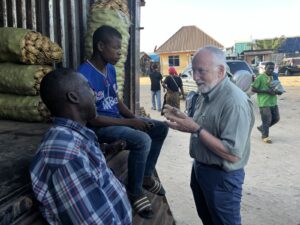
 2024-09-14. The TBM sales warehouse in Dar es Salaam is sold out, with only a small amount of rice and wheat flour left. Transport and supply are lagging far behind the needs of local small restaurants. Bahat explains to farip Foundation President Peter Reinhard: “We’re going to put pallets on the floor here to improve storage conditions.” Meanwhile, Queen is waiting at the point-of-sale, for which she’s also responsible next to running her street food: “The TBM truck is coming this afternoon. It’s bringing me a large bag of potatoes, which I’ve already paid for by phone. By evening, I’ll be able to serve the ever-popular fried potato chips at my restaurant right next door.”
Institute of Development Studies at the University of Dar es Salaam
 Dar es Salaam, 2024-09-10. The first stop on the farip delegation’s journey through Tanzania is the Institute of Development Studies at the University of Dar es Salaam. During the kick-off meeting, the university outlines the topics it plans to research. Institute Director Colman Msoka states: “Tree-secured loans have great potential to promote rural development. We absolutely need to develop our research questions on-site in Magunguli, during conversations with the local villagers.”
Read more about the tree-secured credit for rural development mechanism here.
University Visits GRACOMA Field Laboratory
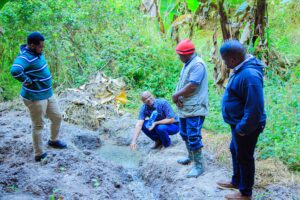 Magunguli, 2024-06-01. The University of Dar es Salaam UDSM is now also interested in the tree-secured credit mechanism. Dr. Colman Msoka, the head of the Institute for Development Studies IDS at the university, and his assistant Dr. Patrick Mlinga traveled to Msowero, to prepare their on-site research cycle on biodiversity and smallholder loans. Dr. Colman Msoka commented, «Tree-secured loans have great potential to promote rural development.»
Accompanied by Bahat and Elibariki, farip‘s local partners, the institute’s leadership visited not only farmers but also to engaged with local authorities and banks.
Read more about the GRACOMA credit mechanism here.
GRACOMA
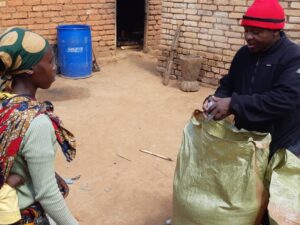 Magunguli, September 15, 2023. Small-scale farmers in Tanzania don’t have access to bank loans, so they need to find their own ways to finance their investments. One example is through their own GRACOMA credit system: Ten farming families in Magunguli received a GRACOMA loan a few months ago and used it to grow potatoes and beans on their fields. They’ve now had a successful harvest, which was marketed well in Mabibo, a suburb of Dar es Salaam. The farmers were able to pay back the loans with interest, and they have earned a decent amount of money.
GRACOMA is an experiment that registers forest trees and uses them as collateral for loans. It wasn’t at all certain that such a credit system would work in practice. Until now, it was mainly theoretical discussions that were carefully considered by our project partners in Tanzania. With the success of this first attempt in the fields, we have now achieved a significant milestone: GRACOMA works in practice!
Testing the suitability of the GRACOMA idea
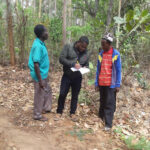
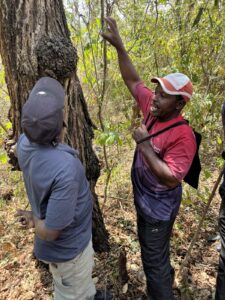
Magunguli, spring 2023. Our local partner and trustee Elibariki Tweve visits a forest plot of farmers in Magunguli. He is about to register the trees growing there as loan collateral. Five farmers intend to use the loan to invest in seeds and work force. Each of them intends to cultivate one acre (just under half a hectare) of beans. With this small-scale test run, farip is testing the suitability of the GRACOMA idea, which was developed by the farmers themselves: GRACOMA (Growing Assets Collateral Management) is designed to enable farmers who previously had no access to credit to offer growing trees as collateral for loans. “If this experiment succeeds as the farmers envision, we will have made an important breakthrough for the independent financing of projects in rural areas,” Ueli Scheuermeier, CEO of farip, is pleased to say.
The local liaison officer for the trading company TBM
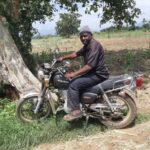 Msowero, early 2023. “Karibu! I’m Menas Yapesa, a farmer in the extensive village of Msowero. I’m also the local liaison officer for the trading company TBM. That means travelling around the area, visiting farmers to look at their fields, maize stores and cows. I also organise TBM’s sale of their produce. The company uses an innovative method here: When it takes over the goods, TBM pays farmers an advance called “cash on the bag”. It then takes care of the marketing in distant towns without any middlemen creaming off profits. TBM guarantees that sales revenues are fairly distributed to the producers. That’s why we farmers prefer working with them.
To do my job, I need a reliable motorbike. When my old one broke down, farip quickly gave me a loan. That meant I could immediately afford a second-hand replacement and continue to ensure TBM’s presence in Msowero.”
Keeping supply chains in their own hands
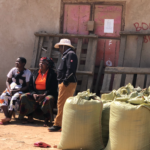
The first point of sales outlet for agricultural products from the inner country is being built here in Makambako
Dar es Salaam, 2022-10-28. The vast majority of low-income earners in the major urban centers in Tanzania struggle to secure food of good quality at reasonable prices – even though this is by far the largest market for agricultural products.
What if the supply of agricultural products from rural producers could be sold through a separate network of points of sale in the cities, providing small amounts of healthy daily groceries in good quality?
A delegation of several members of the farip Foundation has just left for Tanzania to explore such a points of sale project in more detail. Among them are two students of the University of St. Gallen (HSG). They volunteered to dedicate their Master theses in Business Innovation to helping farip with a scientifically solid proof of concept/feasibility study. (Kudos and many thanks!)
The project idea is to set up small warehouses for depositing goods along the route of a truck providing “transport-by-schedule”. Customers like Fatuma with her cookshop could store their deliveries there and pick them up according to their daily needs. A prototype of a point of sale in Dar es Salaam is on this blog’s illustration. Stay tuned to read more about it here soon!